Training Splits I Use and Why
- Duncan Roman

- Apr 22
- 5 min read
Three frameworks for weekly training splits, when to use them, and why the structure matters as much as the work inside it.
One of the more practical decisions a coach makes when building a program is choosing how to structure the training week (microcycle). Not just how many days, but how the stress is distributed, where recovery lives, and what qualities are being targeted on which days. Get the structure wrong and your otherwise well-built sessions can have opposite the effect you had hoped. In the end, these splits are here to help us coaches manage training load on a weekly and monthly basis to hopefully ensure the athlete doesn’t get chronically fatigued/sore.
There is no universally superior split. Each of the three frameworks below has a specific use case, and our job as the coach is to understand each well enough to match it to the athlete in front of them. Here is how I think about and use each one.
01 UPPER/LOWER SPLIT
4 or 5 days per week. Alternating upper and lower body emphasis.
The upper/lower split is one of the most commonly used and versatile structures available. It allows for meaningful frequency on both upper and lower body patterns while naturally distributing recovery across the week. Each half of the body gets hit twice, with roughly 48 hours between sessions targeting the same region.
In a 5-day version, Wednesday becomes a restoration day, sitting between the two lower body sessions and acting as a deliberate reset rather than a passive off day. In a 4-day version, Friday is off and the week runs Monday through Thursday.
One of the great advantages of this structure is the level of flexibility it allows on the day to day, we can adopt specific themes in each session such as Monday being a power focused day and Thursday being a Strength or Hypertrophy biased session. Or we can run a more vertically integrated program and have elements of Strength, Power and Hypertrophy present in each workout. The flexibility of the 5th day as an option allows for us to add in some intentional low intensity “restoration” work that might otherwise get overlooked (things like mobility work, low intensity aerobic work, specific rehab work if needed).

02 TOTAL BODY SPLIT
2 to 3 days per week. At least 24 hours between sessions.
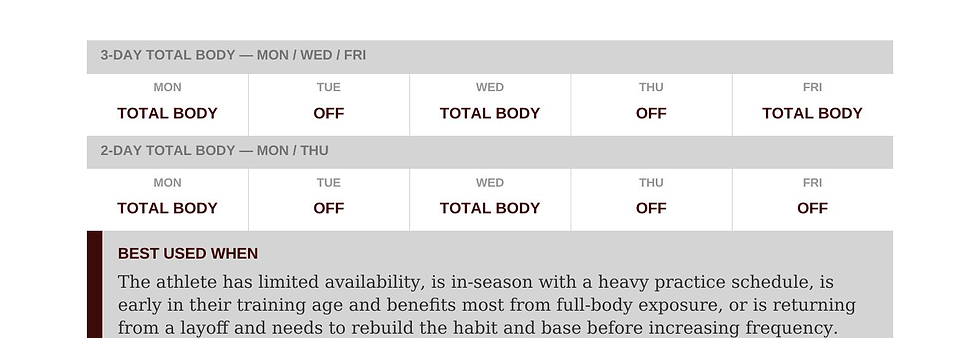
Total body training is the most efficient structure available when session frequency is limited. Every session addresses the whole organism, which means even with two training days per week the athlete is getting meaningful exposure to all major movement patterns and qualities. The minimum gap between sessions is 24 hours, but 48 is usually better.
For a 3-day version, the classic Monday/Wednesday/Friday structure works well. For a 2-day version, any two non-consecutive days' work. The key is not letting the lower frequency become an excuse for lower quality. Each session needs to carry real intent.
There is still a good amount of flexibility within this framework with how you program. What will guide your session decision making is the context of the specific athlete. This would be things like being in season vs off season, the age of the athlete, their goals and current strengths/weaknesses (this is where our assessments come into play – they help guide decision making on the finer details of programs).
An example of how I use this framework with athletes is having at least one high intent day early in the week prioritizing speed/strength/power, followed by a lower intent day that emphasizes higher volumes, lower loads and focuses on building foundational qualities like range of motion, stability, muscle tissue etc. This weekly structure is one I often use with athletes that are in-season.
03 PUSH/PULL OR HIGH/LOW SPLIT
Alternating training intent. High stress days and low stress days by design.
This can be the most nuanced of the three structures, and probably the most underutilized. Rather than organizing training strictly by body region or movement type, this split organizes it by intent and systemic stress. “Push” days aren’t to be confused with the commonly used push/pull split that is used by recreational gym goers (push/pull in that context is referring to the movement emphasis of the day where a "push day" would mean emphasizing pressing movements like bench press etc.)
The way I use this is “Push” days ay synonymous with "High days". They entail heavier load, higher intensities, more CNS demand, i.e. much of work that drives neurological adaptation. The reason they are referred to as “Push” days is because they are emphasizing “pushing” performance/intensity to a higher threshold, or "raising the ceiling" of the available maximum performance of the system. These sessions are more systemically taxing and carry higher downsides (more fatigue, more stress, more soreness, usually decreased performance in the short term).
Pull days, or low days, are the counterbalance: tissue quality work, aerobic development, mobility, and active recovery that supports the high day without adding to its fatigue. These days are fundamental to "raising the floor" or increasing the baseline performance of the athlete. These are just as important as the high days because we are only as good as our worst day, and we can handle much higher volumes of exposure to this type of session. The foundational capacity of the athlete is what allows high performance possible. Too much focus on the “push” day and not enough focus on raising the floor of the athlete and we will see negative outcomes: worse performance, lack of progress, excessive soreness, possible non-contact injuries (strains, pulls etc).
The pairing is deliberate. High days accumulate stress. Low days manage it and build foundation/baseline. Together they create a rhythm that lets you train at a meaningful level more consistently without running the athlete into the ground.
You’ll notice a “medium” day sandwiched in there on Saturday. Simply explained a medium day would be some sub maximal strength work and some higher effort Hypertrophy work. It’s best to make sure we’re not overusing “medium” days especially in weeks with higher concentrations of high intensity days. Again, it's all about managing the fatigue of the athlete, every athlete will respond differently to these structures, and some will handle higher frequencies of High days better than others.

The examples shown in this blog only represent a small fraction of the possible combinations of weekly training splits you might actually implement. It always comes down to what makes sense given the athlete and context. There may be times where an athlete has more than 2 or 3 "high days" in a week, especially when working with athletes during the peaks of their competitive season. What you put inside these frameworks still matters. But choosing the right framework goes a long way at minimizing any unintended downsides (excessive fatigue/soreness).

Comments